

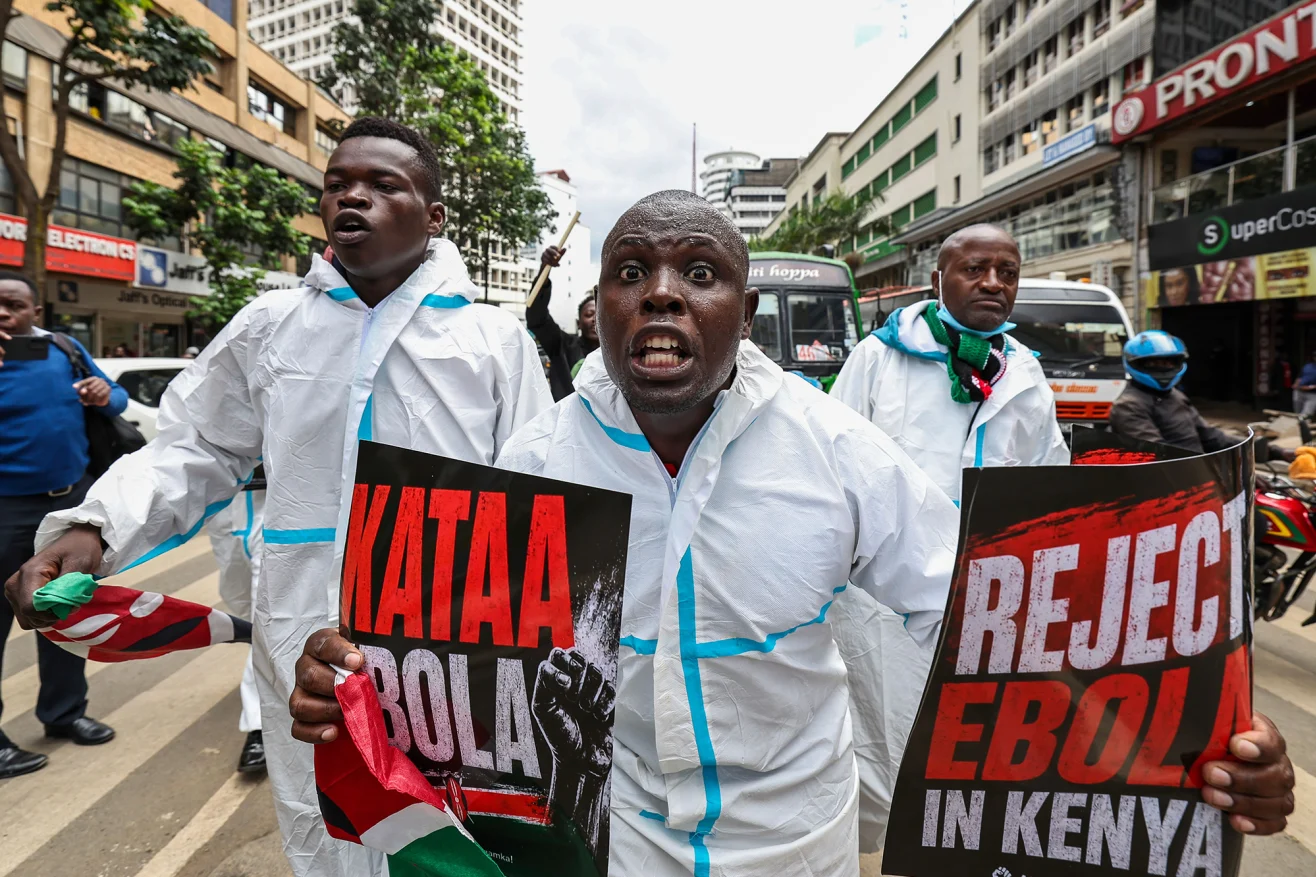
The chants were loud and clear in Nairobi and other Kenyan cities last week: “Kenya is not an American colony!”
Thousands of furious protesters took to the streets to vent their anger at a controversial plan for a US-funded isolation ward designed to treat Americans exposed to Ebola abroad. The irony? Kenya has never recorded a single case of the often-fatal disease. The nearest outbreaks are happening more than 1,500 miles away in the Democratic Republic of Congo and neighboring Uganda.
So why are Kenyans so angry? According to a detailed report from CNN, critics argue that the facility would expose Kenya to risks that the United States would never accept on its own soil. They’re asking a simple but powerful question: If this facility is safe, why not build it in America?
The controversy goes far beyond a single isolation ward.
As CNN reports, this protest is part of a much bigger story: a growing wave of resistance across Africa against what critics describe as Washington’s transactional approach under President Donald Trump. From Kenya to Zambia, from Ghana to Zimbabwe, African nations are increasingly pushing back against deals they see as favoring US interests over their own sovereignty.
Let’s start with what’s happening in Kenya.
CNN reports that despite a court order halting construction of the Ebola ward pending a legal challenge, Kenya’s government has continued to back the project. President William Ruto defended the decision, saying it would be “very inhuman” for Kenya to reject a US-funded facility after years of receiving American aid.
But Ruto’s former deputy, Rigathi Gachagua, who was impeached in 2024, told CNN that the plan reveals a shocking double standard. “We find it unpalatable that if Americans are not willing to take care of their own patients in their own country because it’s risky to the rest of the population, the Americans will decide that that can be done in Kenya,” Gachagua said. “We find it unfair, we find it a double standard, and we are totally opposed to it.”
Here’s the unique perspective that really matters:
What’s happening in Kenya isn’t just about Ebola or an isolation ward. It’s about a fundamental shift in how African nations view their relationships with the United States. For decades, African countries accepted American aid with gratitude and few questions. But now, under Trump’s “America First” approach, that aid is being replaced by dealmaking—and African leaders are starting to ask, “What are we being asked to give up in return?”
CNN’s reporting makes it clear that this isn’t an isolated incident.
According to the report, the US has signed new health agreements with at least 16 African countries, but some have stalled due to disagreements over the terms. The reason? These deals often come with strings attached that African nations find unacceptable.
Take Zambia, for example.
CNN reports that last month, Zambia’s foreign minister, Mulambo Haimbe, said the country was reluctant to accept a proposed $2 billion health package because it required “preferential treatment of US companies over Zambia’s critical minerals” as well as “sharing of data in violation of our citizens’ right to privacy.”
Zambia is a leading copper producer—a key material used in renewable energy, electric vehicles, and power grids. The message was clear: You want our health aid? We want your minerals. And Zambia wasn’t having it.
The same story is playing out elsewhere.
CNN reports that Zimbabwe and Ghana have also objected to proposed multimillion-dollar agreements that include health data-sharing requirements. Ghana’s health minister told reporters, “We need partnerships without strings attached.”
In Zimbabwe, a government spokesperson said the country “was being asked to share biological resources and data long-term, with no guarantee of access to resulting vaccines or treatments.” In other words, they were being asked to hand over valuable health data with no promise of getting anything in return.
And then there’s the Democratic Republic of Congo.
CNN reports that critics are questioning whether Washington’s diplomatic efforts to end decades of conflict in the mineral-rich east of the DRC are driven by genuine security concerns—or by a desire to access the region’s vast deposits of coltan, a mineral used in smartphones and other electronics.
Victor Tesongo, a social rights activist, told CNN that the US cannot be seen as neutral while also seeking access to the DRC’s strategic resources. He dismissed a peace deal signed in Washington last December as a “resource grab,” saying: “The Trump plan has nothing to do with security or the restoration of peace; rather, it is about plundering Congolese resources.”
So what’s really driving this resistance?
CNN reports that the shift began when Trump paused almost all foreign aid and scrapped thousands of aid contracts upon returning to office last year. This marked the beginning of the dismantlement of USAID, cutting vital health and humanitarian funding worldwide—including in Africa, one of the largest recipients of US assistance.
For decades, US funding supported the fight against HIV/AIDS, malaria, and tuberculosis across the continent. Now, those programs are being replaced by Trump’s “America First Global Health Strategy,” which prioritizes direct deals with individual countries. Washington says the goal is to reduce aid dependence while advancing US interests. But as CNN points out, as aid gives way to dealmaking, questions are growing about what African countries are expected to offer in return.
Here’s the reality that every reader should understand:
This isn’t about Africa rejecting the United States. It’s about Africa demanding respect. According to CNN’s analysis, African nations are no longer willing to sign away their strategic assets quietly under the language of aid, partnership, or emergency support.
As Solomon Dersso, founding director of the pan-African policy think tank Amani Africa, told CNN: The US pursuit of its own strategic interests is nothing new. The difference is that it is now happening “more overtly and without pretense.”
What does this mean going forward?
CNN reports that experts see this as a broader shift in how African countries engage with external partners. For decades, the relationship was simple: America gave aid, and Africa accepted it. But now, African leaders are asking tougher questions.
Chitimbwa Chifunda, Zambia director for Oxfam in Southern Africa, told CNN that “the era of waiting for aid is fast slipping away,” adding that recent negotiations show African governments are increasingly willing to push back and defend their interests.
Simon Mulongo, a former African Union special envoy, told CNN that African states “are no longer willing to sign away strategic assets quietly under the language of aid, partnership, or emergency support.” He added that health cooperation “should not become a back door to citizen data extraction” and security partnerships “should not become a route to mineral capture.”
His final words, as reported by CNN, sum it up perfectly:
“This is not isolationism. It is a demand for fair exchange.”
The bottom line, based on CNN’s reporting:
From the streets of Nairobi to the negotiating tables in Lusaka, a new Africa is emerging—one that is more assertive, more independent, and no longer willing to accept deals that benefit the United States at its own expense. The protests over a US Ebola facility in Kenya are just the beginning. This is a story about dignity, sovereignty, and the future of international relations—and it’s only going to get bigger.
Credit: This analysis is based on reporting by CNN, which provided detailed coverage of the protests in Kenya, the growing resistance to Trump-era deals across Africa, and the broader shift in US-Africa relations. For the full story and ongoing updates, visit CNN.com.