

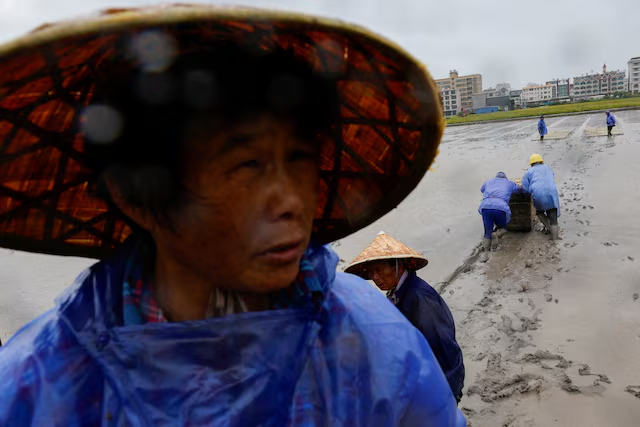
If you think your weekend plans got ruined by bad weather, imagine being one of nearly 2 million people told to grab what you can and get out of your home—fast. That’s exactly what’s happening right now in eastern China, as Typhoon Bavi barrels toward the coastal city of Wenzhou, home to about 10 million people.
According to the Reuters news agency, Chinese authorities didn’t wait around—they ordered more than 1.8 million residents to evacuate on Saturday alone, moving entire neighborhoods to safer ground before the storm even hit.
Here’s the scale of this thing: Reuters reports that Bavi’s rain bands stretch across an area roughly the size of France. That means even though the typhoon is slowly weakening as it moves over cooler ocean water, it’s still carrying an enormous amount of moisture—enough to dump catastrophic flooding on cities and farmlands alike.
The storm already battered Japan’s southern islands and brushed past northern Taiwan, bringing violent winds and heavy rain that knocked down trees and swelled rivers.
So what does this actually look like for regular people on the ground? Reuters spoke with Wenzhou resident Huang Xinghuan, a 50-year-old who was out buying groceries at a wet market before it closed for the storm. He told reporters he’s a little worried but not panicking—his family has stocked up on two to three days of water, and he trusts that the government has supplies under control.
Meanwhile, in Taipei, another resident named Yeh Mao-hsiung was casually walking his dog in the wind and rain, telling Reuters it’s “not that serious.” But don’t let that fool you—Taiwan still evacuated over 14,000 people from mountainous areas, cancelled more than 1,200 flights, and closed schools and offices across the island as a precaution.
Now, here’s the heartbreaking part that Reuters also highlighted: while Japan and Taiwan haven’t reported any deaths from Bavi so far, the storm made things worse in the Philippines, where heavy rains triggered by the typhoon’s outer bands have already killed 17 people.
That’s a stark reminder that even a storm that’s “weakening” can still turn deadly when it dumps rain on already-soaked ground.
Back in China, Wenzhou residents like Chen Qiuqin, a woman in her 60s, told Reuters she was heading to her elderly parents’ home to move flowerpots off the balcony—because even small things can become dangerous projectiles in hurricane-force winds.
Her calm attitude reflects what many locals feel: they’ve been through typhoons before, they know the drill, and they trust the evacuation orders. But with the storm expected to make landfall early Sunday morning, the next 24 hours will be critical.
The bottom line from Reuters’ coverage: this is a massive, well-organized response to a very real threat. If you have family or friends in the affected areas, now is the time to check on them. And if you’re watching from afar, remember—storms like Bavi don’t care about borders.
They remind us that nature can upend millions of lives in a single day and that early evacuation saves lives. Stay safe, stay informed, and don’t underestimate a storm the size of France – even when it’s slowing down.
Credit: Reuters