

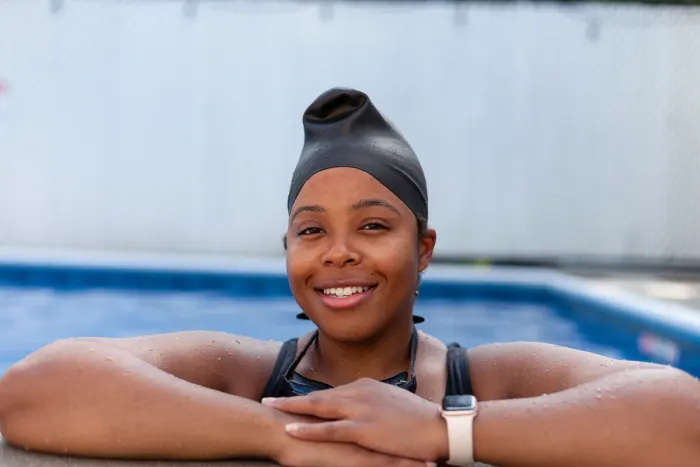
Paulana Lamonier wants to help people be healthier, make sure water is safe for everyone, especially in BIPOC communities, and fight against harmful stereotypes.
Those who can swim may take that ability for granted, but Paulana Lamonier knows that for some people, it isn’t that easy—which is a shame, because the act of swimming can be life-changing for both physical and mental health. More than that, not knowing how to swim can put people at an increased risk of drowning.
That’s why she founded Black People Will Swim, an organization that aims to teach more people in the BIPOC community to swim while also working hard to break down deeply ingrained stereotypes. Here’s where her mission comes from—and why it’s so important to her.
How a Troubling Realization Ignited a New Mission
Lamonier learned how to swim as a child through a local low-cost “learn to swim” program and eventually ended up joining her college swim team, where her coaches encouraged her to combine her swimming knowledge with a natural knack for teaching and supporting others. She has been helping people learn how to swim since 2009, but really got serious about it a decade later.
In 2019, she embarked on a challenge to teach 30 people to swim, but quickly smashed that goal and eventually found herself with so many prospective students that she recruited her sister, cousin and others to get certified and join her as swim instructors.
A memorable moment with one of her students led to an epiphany for Lamonier. “I had one lady in my class who said she couldn’t swim because her bones were too dense. And I’m like, ‘Girl, where did you hear that from?’ And that’s when I did my research about the drowning rates in the [Black] community. However, the barrier [of a persistent stereotype] is what really alarmed me to start the organization.”
That incident gave Lamonier a new focus and inspired the name of the organization she founded. As explained on its website, Black People Will Swim has a simple mission: “We are smashing the stereotype that Black people don’t swim.”
Increasing Safety Through Swimming Competency
While all stereotypes are harmful in various ways, Lamonier says this one is physically dangerous and potentially life-threatening because it discourages many Black people from learning how to swim—which puts them at greater risk of drowning.
According to the Red Cross, 64% of Black children have few to no swimming skills, and Black children ages five to 19 drown in swimming pools at rates 5.5 times higher than white children in the same age group.
Lamonier says teaching children to swim often involves breaking a family pattern, as parents who can’t swim are much more likely to have kids who can’t swim. She notes that Black children, particularly in low-income areas, have also faced additional barriers over the past few generations including segregation and lack of access to public pools.
The organization is working to change the tide and is already achieving impressive results. Lamonier said 400 students participated in the program this summer, and around 250 are registered for the fall.
Lamonier says the moment when people make a pivotal breakthrough and feel confident in their swimming ability can be emotional for everyone involved.
“There have been times when I’ve been brought to tears,” she says, recalling an experience with a mother around 65 years old who took the class with her daughter. “She was near tears because she didn’t think that jumping into 14 feet of water and learning how to tread water was something she would ever do in her lifetime.”
Health Benefits Are a Nice Bonus
Although increased safety through swimming competency is the main motivation for the program, Lamonier notes that participants also see health advantages, as well. “That’s definitely a benefit that we’ve noticed, especially with the older folks who resort to swimming because it’s easier on their joints.” She notes that pool-based exercise can build strength and endurance—and burns more calories than people might think. “It’s no joke. Water aerobics will humble you.”
Pushing For a National Movement
The organization currently only offers classes in New York City—though Lamonier is working towards expanding the scope—but Lamonier and her colleagues serve as vocal and passionate advocates pushing for more accessible swim safety and instruction programs nationwide.
They also encourage people across the country to sign up for swimming lessons in their area and urge them to commit to learning to swim by making a pledge on the Black People Will Swim website. Those who submit their online promise will receive occasional messages via email or text message to keep them motivated and help them stick to their swim-related goals.
SOURCE:PARADE