

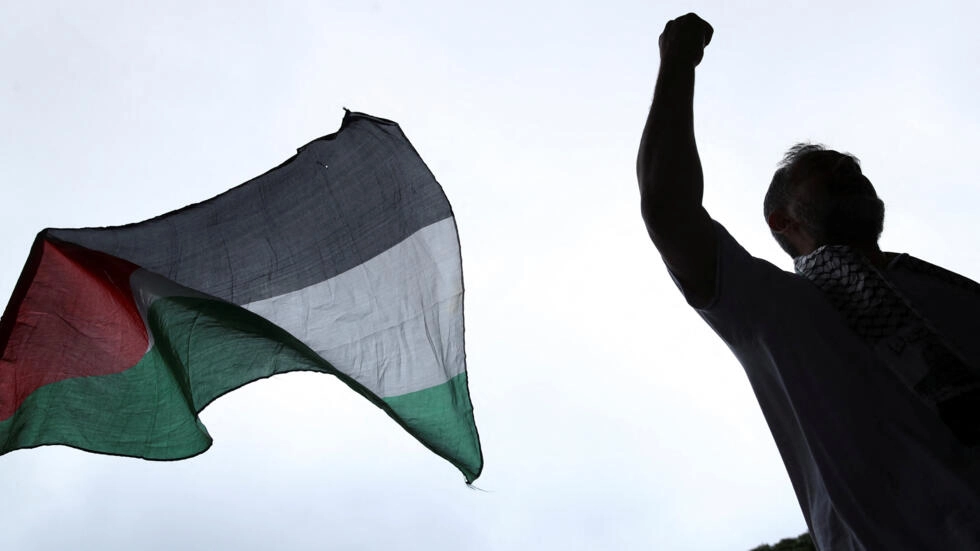
Different parts of the world had different opinions about the attack by Hamas on October 7. Some were upset about the harm to Israeli civilians, while others were upset about harm to all civilians in the Israeli-Palestinian conflict. As things in Gaza get worse, there are more disagreements among Western countries.
US President Joe Biden’s visit to the Middle East was important. He’s experienced in politics and came to a place with a long-lasting conflict that was in a serious situation. The visit was meant to show that the US is focusing on this region again after a shift in recent years. The US still has the power to bring upset regional leaders together.
But when President Biden arrived in Tel Aviv and met with Israeli Prime Minister Benjamin Netanyahu, it seemed like the US, who was once seen as a fair mediator in the Middle East, was not as strong and trustworthy as before.
After Tuesday night’s devastating strike on a hospital in besieged Gaza, Jordan’s King Abdullah II, Egyptian President Abdel Fattah al-Sisi and Palestinian President Mahmoud Abbas cancelled their scheduled meeting with Biden.
The fair mediator came a long way, but only talked to one side. This made the US seem more biased than ever in this long-standing problem. The recent bombing at the hospital made things even more complicated. It’s hard for President Biden to be seen as a fair peacemaker now.
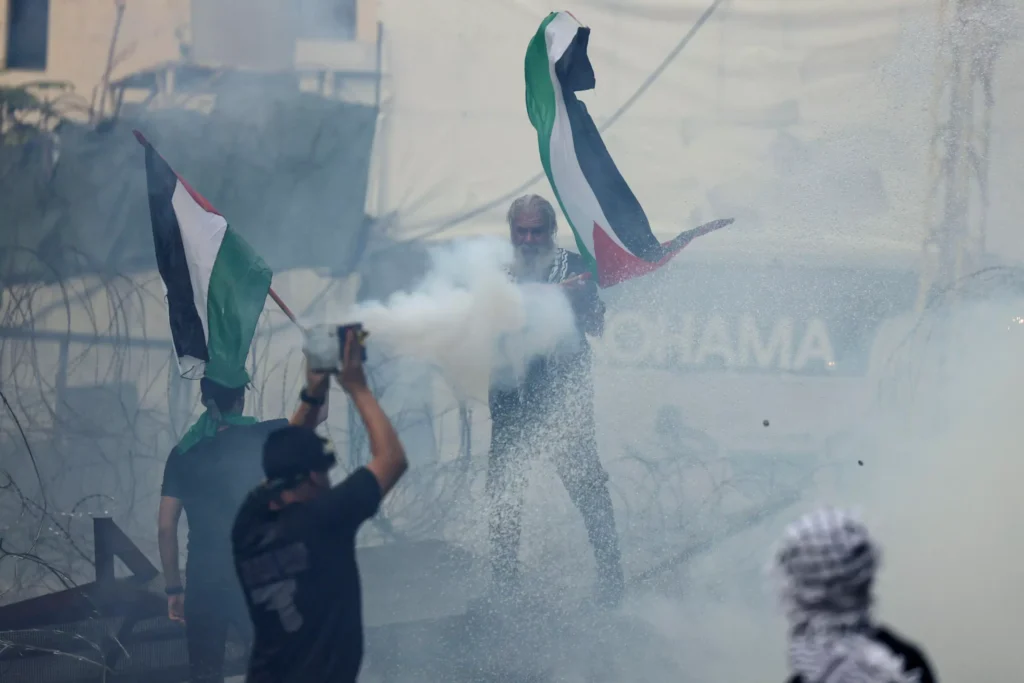
Israel and Palestinian groups, Hamas and Islamic Jihad, blame each other for the hospital attack. Without an independent investigation, Israel’s explanation that it was a mistake by Islamic Jihad didn’t calm down the anger in the Arab world. There were protests in many places, like the West Bank, Jordan, Lebanon, Tunisia, Iran, Libya, and Yemen. People were demonstrating in front of the embassies of powerful Western countries like the US, UK, and France.
Anger on the “Arab street” is one of the clichés of the Israeli-Palestinian crisis, which at times plays out along predictable lines.
But more than a year after the West suffered a rude shock when the countries of the Global South stayed neutral on Russia’s invasion of Ukraine, patience is running out on the old ways of doing diplomatic business. When castigated over their failure to uphold the tenets of international law, Global South countries have cited the West’s “double standards” as well as its selective response to aggression and the use of asymmetric force.
If the Russian invasion of Ukraine exposed divisions in the international community, the latest Israeli-Palestinian conflict is tearing it apart, particularly among emerging powers in Asia, Africa and Latin America, many of whom do not share the Eurocentric histories of the old major global players.
The current Middle East problem is causing disagreements not only between different parts of the world but also annoying some of America’s European friends. These allies have been trying hard to agree on following global rules and treating all people fairly since Russia invaded Ukraine.
‘Selective rules of the game’
After the October 7 attack, different countries had different reactions. Some focused on condemning the Hamas attack on Israel, while others also mentioned the bigger Israeli-Palestinian conflict.
Leaders from the US, France, Germany, Britain, and Italy released a joint statement supporting Israel and condemning Hamas. They briefly mentioned the Palestinian people’s legitimate hopes, but didn’t explain how to achieve them.
South Africa, for example, called for an immediate stop to violence and for peace between Israel and Palestine without naming Hamas.
A French journal categorized the responses into three groups: those strongly supporting Israel, those calling for a ceasefire, and those supporting Hamas.
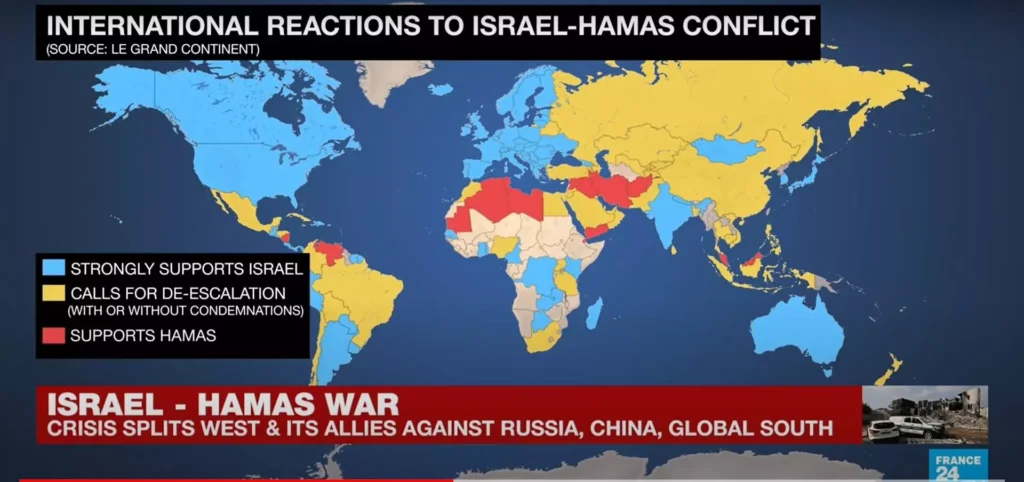
The current crisis is definitely causing more disagreements. It’s making the Global South believe even more strongly that the West has double standards. According to Michel Duclos, a former French ambassador and special advisor, the conflicts over Ukraine were mostly about money and power. But the Israeli-Palestinian issue is deeply emotional, and newer countries are getting impatient. They feel that the West favors Israel emotionally, which seems unfair to them. They see it as the West choosing based on feelings rather than fair rules.
US casts a shock UN veto
The Global South doesn’t have one unified stance in situations like this, explained Sarang Shidore from the Quincy Institute for Responsible Statecraft. The important thing is whether there are enough significant Global South countries that care about this issue and are ready to stand up and express their opinions. And the answer to both questions is yes.
The nature of the response, according to Shidore, would depend on developments in the Gaza Strip. If the humanitarian situation in the besieged Palestinian enclave deteriorates, some Global South countries could push for a UN General Assembly vote, particularly if the stalemate in the 15-member UN Security Council continues.
On Wednesday, as Biden was telling reporters in Tel Aviv that he convinced Israel to allow limited humanitarian aid into Gaza, the US was playing a different tune at UN headquarters in New York.
The resolution, sponsored by Brazil, condemned violence against all civilians, including “the heinous terrorist attacks by Hamas”. Twelve countries in the 15-member Security Council voted in favour. Russia and the UK abstained. The US, a permanent Security Council member, cast the decisive veto. US Ambassador to the UN Linda Thomas-Greenfield criticised the resolution for not saying anything about Israel’s right to self-defence.
It was the second UNSC resolution on the Israel-Hamas conflict to fail. On Monday, the Security Council rejected a Russian-drafted resolution that called for an “immediate ceasefire”, “unimpeded” humanitarian access to Gaza, and a condemnation of “all” civilian killings, Israeli and Palestinian.
The US, UK, France and Japan voted against the Russian resolution. At that time, Thomas-Greenfield slammed Moscow for failing to mention Hamas in the draft text.
No to ‘ceasefire’, yes to ‘duty to respond’
Semantics are serious business at the UN, and it was not merely the omission of Hamas, but also the inclusion of the word “ceasefire” that ensured the Russian resolution was dead on arrival.
Shortly after Israel started pounding the Gaza Strip last week, the US State Department sent a directive warning US diplomats against using three specific phrases: “de-escalation/ceasefire,” “end to violence/bloodshed” and “restoring calm”, according to a Huffington Post report, which was confirmed by the Washington Post.
Washington meanwhile has tweaked its commitment to Israel’s “right to respond”, upgrading it over the past few days to a “duty to respond”.
The Brazilian draft UNSC resolution was put to vote after days of difficult negotiations and two delays in a bid to get a consensus. Following Wednesday’s veto, China‘s UN Ambassador Zhang Jun accused the US of leading Security Council members to believe the resolution could be adopted after it did not express opposition during negotiations. He described the vote as “nothing short of unbelievable”.
The US traditionally shields its ally Israel from any Security Council action. But this time, Brazil – a founding member of the BRICS bloc of emerging economies who currently holds the rotating Security Council presidency – released an irked statement regretting Washington’s blocking of the vote.
“Brazil considers it urgent for the international community to establish a ceasefire and resume the peace process,” said a Brazilian Foreign Ministry statement.
EU splits burst out in public
For the first time since the October 7 Hamas attack, France broke ranks with its Western allies on the Security Council on Wednesday, when it voted in favour of the Brazilian draft resolution.
In its statement, the French foreign ministry expressed “regret” over the failure at the Security Council. “The text unequivocally condemned Hamas’s terrorist attacks against Israel, demanded the release of hostages, urged respect by all for international humanitarian law,” noted the statement.
Israel’s deadly bombardment of the Gaza Strip after blocking fuel, water, medication and food supplies has sparked rifts in the US-EU partnership that are mostly contained within closed doors but have occasionally erupted in public.
At an emergency video summit of EU leaders on Tuesday, several leaders warned that failing to uphold the rights of Palestinians in Gaza risked exposing Western states to the charge of hypocrisy, the Financial Times reported on Wednesday, citing multiple officials briefed on the discussion.
European Commission chief Ursula von der Leyen has faced a backlash from EU leaders and lawmakers for not explicitly calling on Israel to respect international law in its war on Gaza during a trip to Israel last week.
“The Europeans are getting concerned about being viewed as not standing up for international law. Ursula von der Leyen’s stance of unreserved solidarity for Israel is being seen as one-sided and causing them to lose soft power in the Global South. Europe depends more on soft power than the US, which often relies more on hard power, though that is increasingly turning out to be counterproductive,” said Shidore.
Both the US and the EU have increased humanitarian funding for Palestinians since the Israeli bombardments following the Hamas attack. The EU’s aid to the Palestinians is the “price of their guilty conscience about the disappearance of the prospect of the creation of a Palestinian state alongside Israel,” noted French journalist and writer Gilles Paris in Le Monde.
The question, though, is how long will Brussels tolerate the repeated Israeli destruction of Gaza infrastructure funded by the EU. The 27-member bloc has long been divided over the issue, but the debate has been held behind closed doors. If the EU decides to move the debate on to the public and policy stage, it could receive considerable help from the Global South.
The US has the military hardware to weather differences with its European allies over the Israeli-Palestinian issue. But it will not gain friends in the soft power competition, and both Russia and China are ready and able to take its place in the Global South community that is emerging to change the existing world order.
SOURCE:FRANCE24