

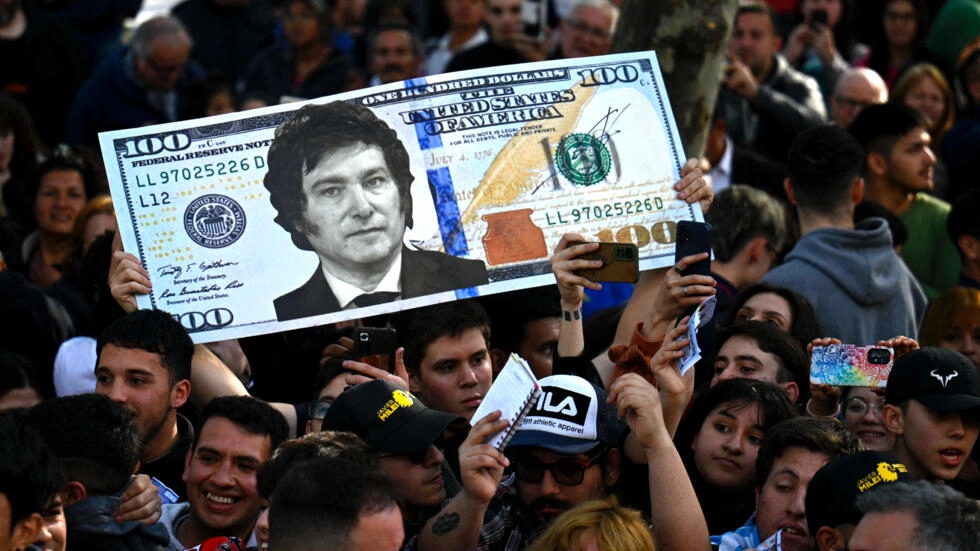
Javier Milei, a candidate for president who believes in extreme free-market ideas, gained popularity in the August elections with his ‘Liberty Advances’ group. He’s getting attention because he suggests using the US dollar as Argentina’s main currency. Many people in Argentina, tired of high prices and more poor people, think this could finally fix the economic problems they’ve been facing since 2018.
In Argentina, prices are going up a lot, and the country’s money lost its value a lot in August. It feels like Argentina’s economic troubles are never-ending. That’s why many people weren’t surprised when Javier Milei, a candidate who wants big changes in how the economy works, became popular. He’s all about a type of capitalism from the US that wants the government to do as little as possible.
Milei, who used to be an economist and now gets a lot of attention in the media, did really well in a big vote on August 13. He got almost 30 percent of the vote, which was way more than anyone expected. He even beat other important candidates, like Patricia Bullrich and Sergio Massa.
Since then, this strong-willed candidate’s ideas have become really important. He wants to make big changes, like getting rid of what he calls the political ‘elite,’ which he compares to rats. He also wants to get rid of the central bank and eight government departments, including health and education.
He’s thinking about changing the rules about abortion, which Argentinian women just won in 2021, and he wants to get rid of all the laws protecting the environment. But the most talked-about idea is his plan to switch from using the peso to using the US dollar, which is called ‘dollarization
Rejection of the political class
According to Gaspard Estrada, who leads a group studying politics in Latin America, Javier Milei’s message is getting attention because people believe he could bring about real change. After the presidencies of Mauricio Macri and Alberto Fernandez, who led Argentina from different sides of politics, the country faced problems like rising prices, money losing value, the Covid-19 pandemic, and not having enough money in the budget. This made more people poor. When Milei talks about cutting government spending and shows big pictures of himself on 100-dollar bills, it resonates with many who are frustrated with the political leaders who don’t seem to have good solutions for Argentina’s never-ending economic problems.
Is it even possible?
Since becoming the favorite, the ex-economist has adjusted his plan. Now he talks about a ‘competition of currencies’ where the dollar would eventually win. Many experts don’t think this idea will work. Eduardo Levy Yeyati, like other economists, says that to switch to the dollar, Argentina needs a lot of actual dollars – about $20 to $25 billion in cash. But Argentina’s central bank doesn’t have that much. Getting a big loan from international markets is very hard for Argentina, a country often close to not being able to pay its debts. The IMF, which has been a big part of Argentina’s economy for a long time, is worried. They say that just using the dollar isn’t enough, and that Argentina needs to have good financial plans. That’s what a spokesperson said on September 28th

According to economists close to Milei, like Emilio Ocampo, who would lead the central bank if Milei wins, this isn’t a big problem. Ocampo believes that in reality, ‘dollarization’ has already happened because Argentinians have about 245 billion dollars in cash or foreign accounts, even though there are strict rules about exchanging money. The candidate often says, ‘Argentinians have already picked their money,’ referring to how many people rush to change their pesos into dollars.
Dreaming of dollarisation
People in Argentina are thinking about using the dollar, but they might be forgetting what happened last time they tried it. Back in 2001, when they tried this before, it turned out really bad. There was a big problem with banks, violent protests, people losing their savings, and a lot more poverty.
In the 1990s, the president at the time, Carlos Menem, wanted to fix the huge inflation problem, which was at 2,000 to 3,000 percent a year. He made a rule where one dollar was equal to one peso. This meant no more crazy inflation. This decade is remembered as a time when things were really good, especially for the middle class who suddenly had a lot of dollars and could afford more. They even call it the “pizza and champagne” years.
Using the dollar as a solution during economic troubles hasn’t worked well in other Latin American countries either. Only three countries in the whole continent have tried it: Panama in 1904, Ecuador in 1999, and El Salvador in 2000.
But there’s a difference. These countries are usually smaller than Argentina. Also, El Salvador and Ecuador get a lot of dollars from selling oil (in Ecuador’s case) and from people who live and work in the US sending money back to their families (in El Salvador’s case).
He said, ‘This means Argentina won’t have control over its own money policy, it will depend on the United States’ decisions.’
But these technical arguments probably won’t stop Argentinians from hoping for dollarization. The finance minister, who might face Milei in the second round of the presidential election according to recent polls, only suggests the usual solutions: print more money and increase the budget deficit.
This election is about making a change, and the question is which candidate can bring a change that will make Argentinians feel more secure,” Estrada explained. “One of the main things Argentinians will consider is the economy and the willingness to try new economic policies. From this perspective, Javier Milei has a strong advantage if there’s a second round.
SOURCE:FRANCE24