

India Wants to Reduce Its Dependence on China—But It Won’t Be Easy
India is trying to reduce its dependence on China, but one major problem remains: many Indian factories still need Chinese products and materials to keep running.
A simple visit to a toy shop in India tells an interesting story about the country’s difficult economic relationship with China.
According to the BBC, India has managed to reduce its dependence on Chinese toys after taking strong steps to support local manufacturers.
But the success of India’s toy industry has been difficult to repeat in other parts of the economy.
How India changed its toy industry
About six years ago, India increased taxes on imported toys.
Import duties were raised from 20% to 60% and eventually to 70%.
The government also introduced stricter quality requirements to prevent poor-quality toys from entering the Indian market.
At the time, some Indian retailers complained that local manufacturers would struggle to compete with cheaper foreign products.
But the policy eventually produced results.
The BBC reports that India’s toy imports fell from almost $300 million in 2020 to about $100 million, while toy exports increased from around $129 million to $200 million.
India also reduced its dependence on China, which previously controlled about 70% of India’s toy market.
This makes the toy industry an interesting example of what India could achieve if it successfully applies similar strategies to other industries.
But the bigger China problem is growing.
Despite the progress in toys, India’s overall trade relationship with China has moved in the opposite direction.
According to BBC reporting, India’s trade deficit with China has increased dramatically.
The deficit grew from about $44 billion in 2020 to roughly $112 billion.
A trade deficit means a country is buying much more from another country than it is selling to that country.
In India’s case, the country is importing huge amounts of Chinese products while struggling to increase its exports to China.
Kevin Zongzhe Li of the Asia Society Policy Institute told the BBC that India’s economic dependence on China has continued to increase even while political and security relations between the two countries became much worse.
This creates a major challenge for India.
India needs China to keep many factories running.
The problem is deeper than Chinese-made consumer products appearing in Indian shops.
India increasingly depends on China for parts, raw materials, chemicals, machinery, and other industrial products.
This means that even when an item is manufactured in India, some of the important parts used to make it may come from China.
For example, India has become an important producer of smartphones.
The country now produces more than a quarter of the world’s iPhones.
However, the BBC reports that much of this production still involves assembling products using components imported from China.
So, in simple terms, India may be making more products locally, but it still needs China to supply many of the ingredients needed to make those products.
That is one of the biggest difficulties India faces.
China supplies many important industrial products
According to figures cited by the BBC from the Observer Research Foundation, electrical machinery and electronics make up about 36% of India’s imports.
Machinery and mechanical equipment account for another 21.7%.
India also imports significant quantities of chemicals, plastics, solar-related products, batteries, and manufacturing equipment from China.
Experts told the BBC that losing access to these Chinese supplies would not only affect consumers.
It could also affect Indian factories themselves.
Factories could struggle to produce goods if they suddenly could not obtain important Chinese components and materials.
This is why reducing dependence on China is much harder than simply telling consumers to “buy Indian.”
China is also producing more goods than its own market can absorb
Another part of the problem is China’s huge manufacturing capacity.
China produces enormous quantities of products ranging from steel and solar panels to electric vehicles.
But China’s slowing economy means that its domestic market may not be able to absorb everything its factories produce.
As a result, Chinese manufacturers are increasingly looking to foreign markets.
The BBC reports that China’s trade surplus is expected to exceed $1 trillion for a second consecutive year.
Some of these products are finding their way into India.
India itself is expanding manufacturing in many areas, creating strong demand for machinery, equipment, and industrial materials.
At the same time, Chinese companies are looking for markets outside China, especially as some Western countries impose tariffs and other restrictions on Chinese goods.
Better political relations may not solve the economic problem.
Relations between India and China became extremely tense after deadly border clashes in 2020.
India responded with several measures against Chinese businesses and products, including restrictions on Chinese mobile applications such as TikTok.
However, relations have recently started improving.
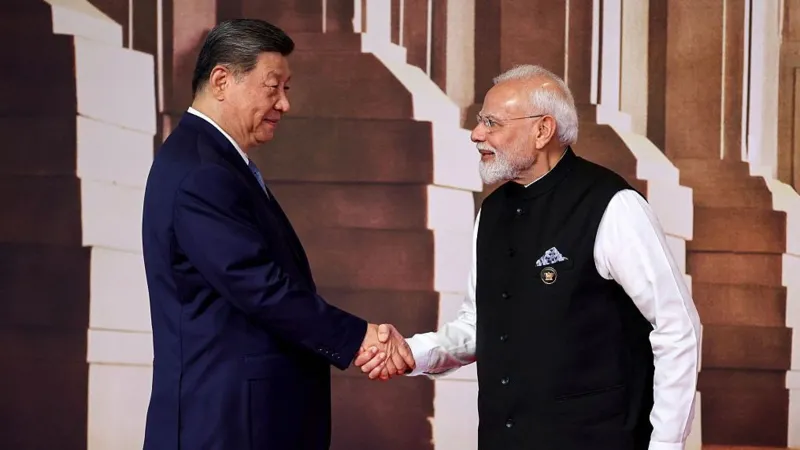
The BBC reports that Indian Prime Minister Narendra Modi and Chinese President Xi Jinping discussed the need to deal with trade imbalances and supply-chain problems during the BRICS summit in Delhi in September.
This could create an opportunity for both countries.
But improving political relations does not automatically solve India’s trade problem.
India still needs to find ways to increase its exports to China while reducing unnecessary imports.
India also wants greater access to China’s market
One major problem is that Indian companies face difficulties when trying to sell more products in China.
According to the BBC, Indian businesses face various tariffs and other restrictions that make it difficult for their products to compete and expand in the Chinese market.
This creates an imbalance.
India buys huge amounts from China, but Indian companies struggle to achieve the same level of access to Chinese consumers.
That is why some experts believe that improving market access should be an important part of any new India-China economic relationship.
Could India learn from its toy industry?
The success of India’s toy industry provides an interesting lesson.
India showed that government policies, higher import duties, and quality controls can help local businesses grow.
But toys are relatively simple compared with industries such as electronics, chemicals, machinery, and batteries.
It would therefore be much harder for India to immediately replace Chinese suppliers in these industries.
The bigger challenge is to develop Indian companies that can produce high-quality components at competitive prices.
That means India needs reliable electricity, cheaper financing, better roads and ports, efficient transport systems, and stable business regulations.
The country also needs more investment in technology and skills.
Chinese investment could help—but India must be careful.
India has recently made some changes that could make it easier for Chinese companies to invest in the country.
This could bring money, technology, and manufacturing experience into India.
But experts warn that India needs to be careful about the type of investment it accepts.
If a Chinese company simply imports most of its parts from China and assembles them in India, India’s dependence on China could actually become greater.
The BBC reports that some experts believe India should instead prioritize investments that bring new technology, produce more components locally, and create products that can be exported from India.
India could look for more products to sell to China.
Another possible solution is for India to increase its exports to China.
Pharmaceuticals could be one promising area.
China has a large and ageing population, while healthcare costs are increasing.
Indian pharmaceutical companies could potentially find greater opportunities in the Chinese market if access improves.
However, experts told the BBC that pharmaceutical exports alone would not be enough to eliminate a trade deficit of more than $100 billion.
India would need a much broader strategy.
The bigger lesson for India
The India-China trade story shows that reducing dependence on another country is much harder when that country has become part of your manufacturing system.
India can reduce imports of finished products, but that is only one part of the problem.
The real challenge is reducing dependence on the parts and materials used to make products inside India.
That is why India’s toy industry is such an interesting example.
India succeeded in protecting and developing its local toy industry.
Now, the bigger question is whether India can repeat that success in electronics, machinery, chemicals, batteries, solar equipment, and other major industries.
My perspective
India does not necessarily need to completely stop buying from China.
That may neither be realistic nor economically wise.
Instead, India’s bigger goal should be to make sure that China is not the only country capable of supplying important products and components to its factories.
If India can build strong local suppliers while also developing new trading relationships with other countries, it would have greater bargaining power.
At the same time, China would remain an important trading partner rather than becoming India’s unavoidable supplier.
The BBC’s report highlights a difficult reality: India may be politically determined to reduce its dependence on China, but economic dependence cannot disappear overnight.
The toy industry shows that change is possible.
The much bigger challenge will be turning that small success into a nationwide manufacturing transformation.
Source: BBC. This article is an independently written and simplified version of information reported by the BBC. We added analysis and perspective to explain the issue in straightforward language.